
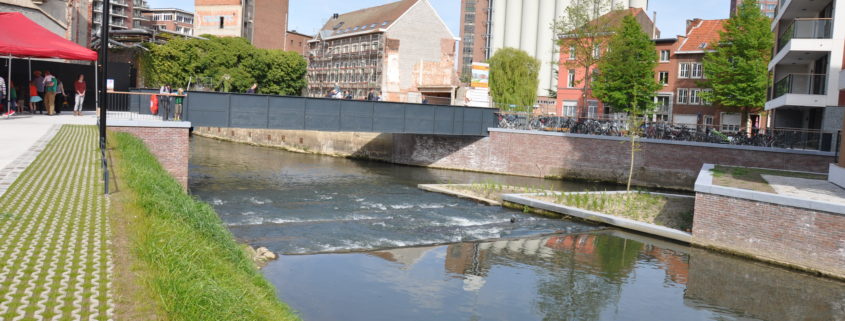
In the Zuunbeek in Sint-Pieters-Leeuw and in the Dyle river in Leuven, we are working on restoring the structural quality, solving the fish migration bottlenecks and increasing the natural water catchment capacity.
1. Restoration of the quality structure of the Dyle in the centre of Leuven
The Dyle flows through the city of Leuven, where it splits up into five different branches. 2 arms of the river on the former Artois brewery site between Mechelsestraat and Vaartstraat were re-opened a few years ago. This created opportunities for nature and the recovery of the river.
The improved water quality has led to 25 species of fish swimming in the Dyle once more. Many of these species, such as chub, ide, gudgeon and roach, swim upstream through the river in the spring to spawn. The head and side waters of the Dyle do make for a highly suitable area for mating and rearing their young, after all.
In the region of Sluispark, the weir in the 4th arm of the Dyle ensures that the water in the river is high enough to feed the canal. At high water, the weir is closed to maximise the flow rate in the Dyle. This weir creates a 1.6-metre difference in height, which means fish can no longer swim upstream. In order to make this fish migration bottleneck traversable for fish, an educational fish ladder has been built beside the weir.
